Tuesday, March 10, 2009

Artist at Play

This afternoon, Jonah and I explored cause and effect, textures, and colors. At the same time, we encouraged motor skills such as reaching with intent! Our activity today was fingerpainting, and although it was messy, it was fun!
First we got dressed into our art clothes. For Jonah, this was just a disposable diaper and a pair of leggings, and Mommy wore an old t-shirt and jeans. This activity can get extremely messy depending on your child's attitude towards it, so be prepared with some moist rags. Also, make sure the paint you choose is non-toxic, as most children try to taste it as they are exploring.I chose three colors. As Jonah gets older, this activity will include allowing him to choose his own colors. Jonah sat in his high chair with a piece of paper on his tray. If you want to prevent your child from crumpling and ripping the paper, you can stick it to the tray with masking tape on the back of the paper. I believe, however, that picking the paper up and handling it is as important as exploring the paints during the first few times with this activity.


One by one, I placed globs of color onto the paper and encouraged Jonah to smoosh it, smear it, and squish it between his fingers. He did try to taste it once or twice, but that is a normal step in exploring at his age. At first he was perplexed by the cold, squishy texture, but soon he really got into smearing it around on his tray. Unfortunately the paper was only half the size of the tray, but I don't mind if he smears the paint outside of the edges of the paper. I left a space of time, about ten minutes, between adding a new color to the paper. Each time that I added a new color, Jonah suddenly became very interested in painting again.

Art activities such as fingerpainting encourage infants to explore cause and effect. They learn that reaching out and smearing the paint causes the color to move around on the paper. This will later translate to means-ends problem solving, when the older infant will observe a problem (I want that toy but can't reach it) and proctor a solution (I can pull this blanket to make the toy come close to me.) It also gives the infant a fun sensory experience, as he feels the texture of the paint, and sees the differences in the colors.

Wednesday, February 25, 2009

Shaker Bottles: A Fun Activity

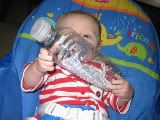
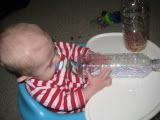
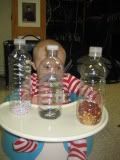
Shaker bottles are a fun and interesting way for your infant to explore the properties of sound as well as develop motor skills! By putting various fillers into the bottles, you can create a sound experiment that is bound to captivate your little one's attention. Jonah loves exploring the different sounds of each bottle, as well as the motion and colors of the fillers. By using fillers of different weights, you are helping your child to learn about physical properties, while encouraging them to lift, shake, and manipulate objects in the world around them. Making these bottles is fun and easy!
Wash and dry plastic bottles from water, soft drinks, or juices. It is fun to have a variety of shapes and sizes, but make sure that your infant is able to easily hold that particular kind of bottle. Sports drinks bottles are large, but offer textured sides that make it easy for infants to grab. Remove the little ring that is usually left behind by the seal of the cap. These are often sharp, and can interfere with gluing the cap on properly.

Fill the bottles each with different materials. It is fun to have some bottles filled with similar materials that differ in one major way. Jingle bells, for example, are fun if you fill one bottle with large bells and another with smaller bells. Try to find materials that have a wide range of sounds when shaken. Strips of cut construction paper, or pom-poms, make extremely soft sounds and would be a great contrast to the jingle bells. Materials I'd recommend for filling the bottles are:
  • colored rice
  • colored pasta (you can fill each bottle with a different shape pasta!)
  • popping corn
  • popped pop corn (the air pop kind, with no salt or butter!!!)
  • sand
  • pom-poms of different sizes and bright colors
  • sand and colored water
  • jingle bells of various sizes
  • a variety of dried beans (pick colorful beans that have different shapes and sizes. Kidney beans and navy beans are a fun contrast!)
  • Construction paper cut into shapes or strips
To color rice or pasta, put the amount of rice or pasta into a ziploc bag and add a couple drops of food coloring. Make sure the bag is sealed properly and shake/knead the bag until the color coats the pasta/rice. Pour it out onto a plate (you might want to use disposable plates, to ensure your nice plates don't get stained with coloring) and let dry over night. This step is great for older siblings, especially if they are learning to mix primary colors (yellow and blue to get green) Have them choose the colors to see what color it makes, or say "we want to make green, which colors should we use?" If you are mixing colors to make a new color, remember that a little goes a long way, and purple is very difficult to get. Add a bit more red than blue, and sometimes a little yellow helps it too!It is also fun to create variety by filling different bottles with varying volumes of each material. Fill one bottle 1/3 full with kidney beans, another bottle 1/2 full, and another bottle nearly full. This creates differences in sound, weight, and the motion of the material when shaken. It is also fun to create themed sets of bottles. You can create bottles that have all red contents, blue contents, green etc. You could create sets of bottles that are opposites: loud jingle bells, quiet pom poms. An earth's elements set would include things like sand, water, twigs, pebbles.

Glue the caps onto the bottles. This is important. Caps can easily come unscrewed and fall off. When this happens, not only is the cap a choking hazard, but so are the contents of the bottles. Also, you will want to replace the bottles regularly. They get chewed on, crunched, stepped on, and some of the materials such as sand or popcorn will begin to break down and leave residue on the inside of the bottles. This residue is completley harmless, but it makes the experience of watching the motion of the objects inside a little less exciting for your child. Always supervise your child when playing with the shaker bottles. This is an activity for both of you to share- the child as the explorer, and you as the guide.

Saturday, February 21, 2009

When I became pregnant with Jonah, I became obsessed with something that most women give very little thought to. How I would feed my baby. I read countless books about how the breast produces milk, went to breastfeeding classes, learned about the politics and economy of formula feeding, and the vast differences between formula and breastmilk. I vowed when I was 20 weeks pregnant, and my colostrum came, that I would never feed my children formula. There was no questioning. I was on my soapbox, and I wouldn't come down.

Over and over, I would tout the importance of breastfeeding to anyone who would listen. I would banter for hours about how manufacturers make formula out to be just as good or sometimes better than mothers milk, when truth be told it is a pale imitation of something that cannot be synthesized. I was very proud to be a so-called "lactivist."

When Jonah was born, the nurses gave him formula without my permission. As I held him for the first time, and he latched on like a pro, I whispered into his little ear not to worry, that was the last time he'd be getting that "crap." He was getting la creme della creme from now on. I kept it a little known secret that he'd ever had that little ounce of formula, and blazoned my "exclusively breastfeeding" title wherever I could. Breastfeeding became more than a way of nurturing my child, it became a way of life for us as we drove through snowstorms to La Leche League meetings, and stood up to anyone daring to ask us to "move to a private location" when feeding out in public. Even on this blog, two posts ago, I set my soapbox down and furiously wrote about the importance of breastfeeding in public. I wanted to nurse Jonah until he self-weaned. Whether that was at two years or five years, I was commited to giving my son that security.

Recently, as you may have read, I was body checked off of my soapbox. Completely devestated as doctors told me to stop nursing, I began mixing bottles of pumped milk and formula for my severely underweight son. It was only going to be temporary, and even though my milk supply had dropped drastically from Jonah only eating two ounces at each feeding, I was determined to get my body to produce milk and get Jonah back to breast and off formula as quickly as possible.

We rented a hospital grade pump; I began taking several herbal supplements; all soda and juice in my diet was replaced with water and high electrolyte drinks. I pumped every hour. Within a week, I saw results. I was able to produce enough milk to provide Jonah with five 6-oz bottles every day, and gave him a bottle of high calorie formula in the evening when I was not able to pump the full six ounces. I was proud, and relieved.

However, a week after that, reality set in. In order to provide as much milk to Jonah, I had to continue to pump every hour. I was also taking a large amount of herbal supplements (under the care and instruction of my doctor and lactation consultant.) I had to stop several activities with Jonah, such as elimination communication, because I was spendig too much time at the pump. Reality truly set in when I realized that he was beginning to cry more, and I was unable to console him (I was pumping.) That is when it hit me: although I was able to keep up one aspect of my parenting that was very important to me, I had to give up everything else that I enjoyed about motherhood. No longer could I read stories to Jonah, laugh and play with him, take him on walks, or do fun enriching activities with him. No, I had no time for those. Pumping took about a half hour itself, another twenty minutes to sterilize everything and wash bottles, then Jonah needed to be fed, changed, put down for naps etc. There was just no time for these "extras." But were they really extras that were being cut out, or was I putting a greater need for love and affection and bonding aside, just so I could provide Jonah with a bit of breastmilk.

My milk supply dropped severely, and I began needing to pump even more frequently to provide even half a bottle of breastmilk with each feeding. This is when I decided that these few ounces of breastmilk are not worth jeapordizing everything else in my parenting methods. I had chosen breastfeeding above all else, to bond with my child. How could I bond with him when I am constantly hooked up to this mechanical device trying to provide a tiny bit of milk. It was a difficult decision, but one that had to be made. Since making the decision to give Jonah mostly formula, and stop full-time pumping, both of us have been happier. We've begun signing again, reading together, playing, and starting on Monday, we will jump back into elimination communication.

Harry Harlow ran a famed expiriment with rhesus monkeys to show the importance of love, emotional nurturing, and bonding reaches above the importance of physical nurturing and providing food. He offered infant rhesus monkeys with two choices of "mother figures" made from wire. One mother was just a wire frame, but offered food. The other wire frame was covered in warm cozy fur, and offered comfort and emotional nurturing. The rhesus babies chose to go to the mother offering comfort rather than food, even in extreme cases where the babies were close to starvation.

This experiment backs up my choice, that my son needs a mother who is happy, and able to cuddle and play, even more than he needs those few ounces of milk. I still nurse Jonah from my breast, as we both find it comforting and soothing. The doctor told me that as long as he isn't losing weight, this was okay. Although he still takes several bottles of formula a day, I am hoping that I will be able to continue nursing him for a long time, although full-time nursing seems to be off of the horizon. The doctor would like for me to continue giving him the high calorie formula until he is twenty pounds, which is looking like that will be close to one year old. He is also showing a distinct preference to the bottle when he wants food, but still takes the breast when he needs comfort, before bed and upon waking, for example. Nursing is still something that I feel very strongly about, something that I did not give up without trying everything I could to keep it our main source of nutrition, and something that I believe every mother should do. It still breaks my heart to know that we had everything going for us, and then due to reflux, something that could have been fixed had I been paying attention, Jonah stopped eating. It breaks my heart to think that I used to produce too much milk, and now I barely have any.

But looking at Jonah's chubby little toes, and seeing his baby belly that now does not include a full view of his ribs, I know I am making the right choice. As I sit down with my baby boy to sing to him and make him laugh and see his smile, and then I see my pump sitting in the corner, where a week ago I was sitting, I know that I made the right choice. I love my son, and so I am willing to give up this part of me; I am willing to give him formula with my love attached, to see him stay happy and healthy.

Thursday, February 12, 2009

When everything stops

It has been a very long time since Jonah and I have made an update on our journey together. We have written several posts about cloth diapers, rice cereal, and homemade baby food, however when events took an unexpected turn two weeks ago, I could not find it in my heart to post any of them.

To be told that there is something wrong with her child is a mother's worst nightmare, and even if the ailment is temporary, as parents we live in the realm of "here and now" and everything seems to stop until our babies are well again. Two weeks ago, Jonah and I went to meet our new pediatrician. I suspected nothing out of the ordinary would take place; just a routine visit and an interview to make sure that she was the correct pediatrician for Jonah to see. When they weighed him, my heart sank. He weighed the same as he had on Thanksgiving. He hadn't gained any weight. I knew that he was tiny, and he was skinny, but I truly saw signs of him growing and getting nutrition. I never thought he had stopped growing.

The pediatrician recommended that we go to the hospital. She gave us a choice, but said that if we choose to work as outpatients, it could take months to get answers. With a baby who isn't gaining any weight at all, I wanted answers right away. We were admitted to the hospital Wednesday evening. Testing started immediately. Bloodwork, urine samples, chest x-rays. It was terrifying as a parent. Even worse, upon all of these feelings of fear, the hospital staff began pointing their fingers at Daryl and me. Why is he so small, they ask. That is what we came to find out. Why did it take so long for you to realize, they ask. The same reason it took pediatricians so long to realize. Jonah had been seeing a pediatrician on a regular basis, and this was the first time he had ever been recorded to stop growing. During our week long stay at the hospital I felt humiliated, judged, and inadequate as a parent.

Several aspects of our lifestyle did not fit well into the hospital regiment. Our elimination communication, for example, was seen as something from Mars. When I told the nurse that I could get a urine sample for her without using a catheter, she did not believe me. I stepped out of our room for two seconds, and when I stepped back in, she was inserting the catheter, and of course getting nothing because he had just soaked a diaper. I finally talked her into using a sample cup, but she wouldn't let me catch it. She had to be the one holding it. Of course, the delay between me saying "He's going to pee" and her getting the cup underneath him was too big of a gap, and I ended up spending most of the night getting peed on. The nurse would get impatient, put a bag over his diaper area, and give up. Finally, around three AM I convinced her to leave the cup with me. I caught a sample within a matter of minutes. It was amazing to me that once the impatience and negative energy of the nurse were taken out of the equation, Jonah and I communicated much easier, and EC was facilitated. That was the last time that we used EC, as while we were in the hospital they needed to weigh his diapers. They would not allow me to catch his urine in a cup, it had to be in a diaper- and a hospital diaper at that. No bare bums, no cloth diapers.

Our nursing was also interrupted. It was found that although Jonah nursed, he would only take two ounces of milk for every feeding. His reflux had been so painful that it caused an aversion to eating, and he took in just enough to sustain himself, but not enough to thrive. We began medicating him for the reflux, because we had been using alternative methods to control it previously. We thought our methods were working, as he was no longer spitting up, but that was far from the case. Had we medicated when he was two months old, Jonah would have been a growing, happy, baby today. This has made me sit down and really think about how the choices we make as a parent really do effect our children. It isn't something to be taken lightly, and I will definitely give things a lot more thought from now on. Because of his aversion, we had to teach Jonah to take more milk at each feeding. We also had to stretch his stomach so that it could hold more than two ounces, and train my body to make more than two ounces of milk for him. Jonah was put on a high calorie formula, and I exclusively pumped. Once I began making more milk, I was able to pump for Jonah and fortify the milk, supplementing what my body is unable to make.

This was a very humbling route to take. I have stood on my soapbox several times about formula companies and the harm they do not only to our children but to our relationships with our children. I have ranted and raved about how they sink their claws into the medical community, making mothers believe they cannot or should not use breastmilk. I have come to realize that there are purposes for formula, and sometimes its use is actually for the better for the child. I hear women say "I want to breastfeed for x number of months" but I could never say that. Instead I would say "I don't ever want my babies to have formula." It was difficult to let that go, and even more difficult to accept that because Jonah wasn't taking much milk from me, I may not be able to produce milk through his first year, let alone beyond. It was devestating for me.

We were also bombarded with questions regarding Jonah's solids' diet. I haven't been feeding him solids on a regular basis, and chose avocados as his first food over rice cereal. I did not think this was odd, as several parents I know have done so. My pediatrician stood by me on this decision, as do several books about infant nutrition. However, everyone at the hospital felt the need to question this choice, and "prescribe" rice cereal into his diet.

Last Tuesday, we were given the all-clear to finally go home. Jonah had been eating steadily, and gained a bit of weight. We are continuing to feed him a high calorie diet, but I am pumping nearly enough milk at this point that the majority of his diet is my milk, fortified. And so we begin a new chapter in our journey: pumping.

We have had to stop using EC, mainly because of the amount of time and effort that pumping is taking. I simply cannot physically do both. Hopefully once we get settled into our new routine, we will be able to pick it back up again. We have had a rough start to what looks like a long road ahead of us for pumping and bottle feeding. It is not something I ever planned would be a topic for this particular blog. It has, however become a part of both of our lives, and is becoming more and more crucial to the way we are living our lives.

Saturday, January 17, 2009

The Social Need to Nurse in Public

This post was inspired by a discussion on a webforum for swing dancers, oddly enough.

There has been a lot of media attention on the subject of breastfeeding in public. The main cause being the removal of photos from Facebook showing women nursing their children. At first, I was reluctant to take a stand on the issue. Parenting for me, is not a political statement. However the more I thought on the matter, the more I felt that so-called "lactivism" ran much deeper than a political feminist movement. Lactivists are pushing for a movement that is much needed in our society. Breastfeeding, and public displays of breastfeeding such as pictures, are needed to be seen in western culture for several reasons:
  • To promote the normalcy of breastfeeding
  • To educate the public on the healthfulness of breastfeeding
  • To decrease the number of problems that new nursing mothers face.
The first time that Jonah and I nursed outside of our home, I was embarrassed to the point of mortification. We were at a picnic with friends at Edgewater park in Cleveland. Jonah was less than two weeks old. We had nursed in the car, before making our way to the public park pavilion and had only planned on staying at the picnic for less than two hours. This way, I would not have to worry about feeding Jonah in public. I found the first time out, amongst friends, as a new mother to be refreshing. Two hours passed very quickly, and Jonah was ready to eat before I was ready to leave. My baby was frantic, crying for reassurance that food was nearby. I looked around the pavillion, but saw nowhere secluded or private. I timidly peeked my head into the bathroom, with its rank and rusty stalls. I couldn't stand the smell, much less the thought of feeding my baby in there! Jonah's screams were becoming more real. I sat down at the edge of the picnic area, took a deep breath, and unclasped my nursing bra. Just as I began to lift my shirt, with my flailing screaming newborn drawing attention to the situation, a group of men walked past and looked straight at me. I quickly fastened my bra, and began yet another frantic search. Finally, I pulled the stroller to the corner of the pavillion. I sat between the stroller and the wall, on the floor, hoping no one saw as I lifted my crying baby to my breast.

I am sharing this story, because I think that it is typical for new mothers to feel this way when nursing in public for the first time. Embarassed, frantic, and self conscious. I wish that I could take my confidence in nursing now, and project it onto other new mothers. When a mother is learning to breastfeed, this is not the state of mind that she needs to be in. Luckily for me and Jonah, we have recieved the support that we need to nurse comfortably when we are not at home.

Promoting Normalcy:
The reason that my story is so much like other women's first public nursing experiences, is that breastfeeding is seen as an abnormal behavior. People view it as weird, vulgar, and sexual. The breast is not seen as the vessel that holds nourishment and comfort for an infant or young child, but it is a sexual icon that is only exposed by the lewd and promiscuous. At the same time that it is viewed as a sexual conduit, the breasts also provide entertainment value to performers such as Britney Spears, Madonna, and a list of others too long to provide here. The breast is exciting and forbidding at the same time. It is no wonder with these conflicting views, that the public is easily misled about the true nature of the most miraculous part of a woman's body.

No woman should feel shameful about feeding her child. No woman should feel the way that I did in that park pavillion, desperately wanting to stop her child's cries, but desperately wanting to not offend anyone. The advice I have for mothers who are shy about nursing in public, is realize that if any onlookers are offended, it is their problem and not yours. Typically, I am the type of person who is a people-pleaser. If anyone finds my behavior offensive or awkward, I am embarrassed and quickly work to make the situation right. However, when it comes to nursing, a mother should be concerned primarily about the comfort of her child, and second, her own comfort. Breastfeeding is difficult enough, without having to worry about the comfort of individuals around you. Baby can sense when you are tense and uncomfortable, and in turn that will make him cranky and reluctant to nurse properly. For the best results, nursing in public should be just as comfortable for mother and child as it is in the home.

By giving the public more chances to see women nursing, breastfeeding will become a normal part of society. A child suckling at the breast will no longer seem "perverted" but instead would be publicly accepted. Women would no longer feel ashamed to use their body for what it is naturally designed to do.

Educating the Public: By achieving the above goal of promoting the normalcy of breastfeeding, it will be promoted as not only a normal source of nourishment, but also the best source of nourishment for an infant and young child. The more normal that breastfeeding becomes, the less mothers will turn to artificial baby milk (formula) as their child's source of nutrition. Formula is very useful. If a child should abruptly become seperated from his mother, if the mother became ill and was incapable of nursing, or if the infant was born prematurely and the mother's milk will not come in, are all reasons to use artificial baby milk. However, because breastfeeding has inherited the vulgar reputation through the conotation of the breast, many very capable mothers choose to formula feed their infant instead. Formula is promoted as a food source equal to mom's milk. Women say "why would I go through all of that when I have this other stuff that is just as good! Truthfully, formula is severely lacking when it is compared to breastmilk. It is missing several componants contained in breastmilk, including protiens and acids that promote healthy brain development, and antibodies that help protect the child's developing immune system (Baumslag,Michels "Milk Money And Madness" p 90). It is also missing the organic nature of breastmilk. Breastmilk, unlike formula which stays uniform, changes itself to meet the needs of the child at any given stage of development. The food that a mother is providing through her breasts is tailored perfectly for that child at exactly the moment he is drinking it (Baumslag, Michels p 77). The image that western cultures holds over breastfeeding is the biggest reason that mothers choose to feed their infants inferior food.

The general public is not the only group that needs to be educated. Pediatricians are severely undereducated in the breastfeeding department. I feel that this is due to two things. The first is that the current "normal" way to feed a baby is by formula. The general public wants to be educated in terms of formula fed infants rather than breastfed. For generations, breastfeeding was taboo, and therefor became ignored by the professionals. Anther reason is funding. Formula companies give enormous amounts of money to maternity wards and pediatric practices. All of the growth charts and feeding charts for infants are provided by formula companies and based on formula fed infants (kellymom). Doctors do not seem to know that breastmilk is broken down so perfectly by the human body, that a perfectly healthy breastfed baby will be smaller than a formula fed infant at the same age. Because breastmilk is broken down so completely, the body does not retain the unused portion as fat. A breastfed baby is also less likely to overeat. A pediatrician will urge many mothers to supplement "just one" bottle of formula every night, because their child is underweight. When a mother does this, it causes her body to produce less milk, and with time she will eventually increase the number of bottles given each day, decreasing her milk supply, and finally feeding the baby formula full time, when in fact there was nothing wrong to begin with. Pediatricians will also often tell a mother to wean her child right at twelve months, despite the fact that the World Health Organization recommends breastfeeding for the first two years of life (World Health Organization). The pediatrician is seeing the world through formula fed infants, once again. Formula is not good for all of those wonderful healthy teeth that baby is getting, and neither is the artificial nipple of the bottle from which he recieves it. It is healthy for a formula fed infant to be weaned from the bottle, and given whole cow's milk (which is what his formula was based on.) However, a breast does not equal a bottle. Breastmilk is not harmful to a young toddler's teeth, and in fact promotes healthy teeth(La Leche League International). Sucking on a breast is quite different from sucking on an artificial nipple, and is not harmful for the child. While there is no nutritional value of continuing to give a young toddler formula after his first birthday, breastmilk contains many benefits for both mother and child way past twelve months. The child's immune system is not fully developed and capable of working on its own until at least 18 months of age. During this time, a breastfed child is getting an extra boost of immunity from the antibodies in mother's milk. At the same time, breastfeeding past one year helps protect the mother from certain cancers. These are only a couple of reasons that WHO has reccommended breastfeeding into the second year of life and beyond. If more people see breastfeeding as normal, these truths would become general knowledge, and our child's nutrition would no longer be clouded by the lies of formula companies.

Decreasing the Number of Problems that Nursing Mothers Face: Breastfeeding is not an instinctual behavior. It is a socially learned behavior (Tamaro, "So That's What They're For" pp. 28-29). Any mother can tell you that the day her baby was born and brought to her breast the first time, she stared at the baby, hoping he would tell her what to do next. No lightbulb just turns on. It is a very difficult task to learn, and without proper guidance and modeling it can be downright impossible. Women need to see other mothers nursing. We need the support and commaraderie of other nursing mothers, but above all, we need to see other mothers nurse. By keeping breastfeeding private, we are making it more difficult, and pretty much impossible, for the next generation of mothers to breastfeed. I feel that this is the most important reason why public displays of breastfeeding should be allowed without censorship. I am confident that with more nursing mothers in plain view, the next generation of mothers would have fewer problems learning to get a good latch, figuring out the correct position to hold their infant, what to do if the baby is not latching properly. Fewer women would have the frustration of a screaming infant while not knowing how to feed them. The top reason that women fall back on formula is because they feel frustrated with themselves and resentful towards their baby that neither of them know how to breastfeed. It is a behavior learned by watching others, and by mimicking others.

To close, I would like to say that I have grown more confident in my nursing since that dreadful first experience. I have learned to simply make Jonah and myself comfortable while nursing, and the rest just falls naturally into place. It is so natural, that many people do not realize I am nursing. I nurse while shopping (while he is in the sling,) while chatting to friends, and at restaurants. I have only ever recieved on negative comment about my nursing, at the mall, and I am still amazed at how much it did not bother me. I have stuck to my philosophy of "it's not mine or my son's problem to fix" and I am boosted with the confidence that I am doing the absolute best for my child: providing him with the most perfect form of nourishment, and responding promptly and calmly to his needs rather than frantically delaying them in order to find a secluded place.

other resources:
Ask Dr. Sears
Kellymom
Dr. Jay Gordon

Saturday, January 10, 2009

How Our Experiment with EC Has Changed Our Relationship:

Even though we are still in the early stages of practicing elimination communication (EC), I would like to take a few moments to dedicate a post to the ways in which it has changed our relationship as a family, already. We have barely scratched the surface, and are just now introducing the potty during today's sessions. Today, Jonah seemed to be giving cues that he needed to urinate. Rather than grabbing a cloth diaper to catch it, as I have been (rather successfully, only false predicting two times and never missing a stream!) I decided it was time to introduce the toilet. I took him to the bathroom, held him onto the seat and made the "sss" sound. Jonah looked at me and smiled, but he did not urinate. I decided to be patient and sat with him, making the "sss" noise anytime he seemed to be giving cues of needing to urinate. Each time he smiled at me and cooed, as if amused at my attempts. After about twenty minutes, I decided that I had falsely predicted, and took him back to our flannel blanket to play. He did not urinate for the duration of our activities. I had noticed a pattern before, during our observation, that he seemed to urinate directly following waking from nap. After his naptime, I felt his diaper and it was dry. Back to the toilet we went, and we repeated the episode from the morning: me "sss"ing, and Jonah smiling back. If it weren't for all of the soaked diapers that I've been changing between EC sessions, I would be concerned about him not urinating, but I suppose I just have to fine tune my understanding of his schedule and his cues before he will successfully eliminate in the toilet. I have chosen a more suitable trainer toilet for him, and as soon as it arrives I am anticipating having an easier time introducing him to eliminating in the bathroom. For now, I suppose it is enough to introduce him to the idea of being in these surroundings.
As I said above, I would like to dedicate this post to what EC has done for our relationship, even in these early stages. I want to do this to let my readers realize that EC is more than merely taking the diaper off of the child. I realized before we began that EC was a way in which to nurture and encourage communication from child to mother, but I did not expect it to change the way in which we bond. EC, for us, has helped point out many points in my (old) daily routine that were not at all conducive to the nurturing environment I wanted to promote for my son. For example: upon his waking every morning, I would nurse, change his diaper, and often his pajamas, bring him out to the living room where he would sit in his bouncy while I made my coffee and breakfast. Sometimes I would wear him in my sling as I ate breakfast and browsed the web for news stories, daily weather, and other unimportant items, but most often I would sit with him bouncing in his seat. If he fussed, I would pop a pacifier into his mouth, hand him a different toy, and bounce the seat vigorously with my foot. This seemed to make him happy, "plus," I told myself "I need this time to gather myself, so I can spend the rest of the day being a good mother." This behavior of mine stemmed from my preschool teaching days, when I could relish the moments of the morning quiet, sipping my coffee reflecting on current events, before the mad rush of reality came over me when I entered my classroom. I needed my morning routine then. It helped me to thrive as a teacher. What EC has pointed out to me about this, is that Jonah is in fact NOT happy, patiently waiting for his mommy to start the day. In fact, he can get very distraught over it. I had no idea before EC, because I was not in the habit of watching his every cue, his body language as well as his verbalizations. As soon as we began our observation periods, our morning routine changed drastically. Upon waking, Jonah would be nursed, his diaper removed, and warm clothing placed over his upper body and legs only (leggings became a fast style in our household!) We would then come out into the living room, where I had created a "safe zone" of a large fleece blanket covered in cloth diapers. We would choose some toys, and have quality one on one time. Sometimes, because I do recognize my need to eat, I would snack on granola bars or cereal, but as opposed to our old morning routine, the focus remained on Jonah and the activity that we were doing together.
As I grew more experienced with his cues, we could make our activities more complex. We practice rolling, and sitting up, and there are quite a few occasions when I do in fact put him in the sling so that I can have breakfast or coffee, but again the focus of activity is on Jonah and his communication to me rather than keeping the focus on me and my own desires (wanting to read web forums or the news, wanting to "drink my coffee in peace" etc.) If there is something that is so important to me that I need to do it while diverting my attention away from my child, I now do that during his naps or bedtime, like updating this blog for example.
I do promote independent playing, often times laying him in our "safe zone" with a selection of toys. He rolls around, scooches all over, and explores the toys I have set out for him by reaching for them, groping them, and mouthing them. He does all of this while I lovingly sit back and watch him play. He entertains himself now, with the security of knowing that I will be there when he needs me. At this age, an infant does not merely want his mother, or to be held, it is his need. By answering his cues quickly, I am giving him the assurance that I am there, he will not be left behind. EC has done a lot to help me follow his cues, and see that in fact he was insecure about a lot of situations that I was not paying attention to. It has helped me become a more attentive mother, and more thorough in my caregiving. It has come a long way from the lines of merely dealing with waste and dirty diapers. It has become an extension of my parenting, and as such it needed to make some changes along the way.

Friday, January 2, 2009

Elimination Communication Day 3: An Experimental Trial Continued

As we were continuing our observation sessions for elimination communication, I was beginning to feel discouraged. After hours of watching my son's every twitch, logging the times of every nap, feeding, and elimination, I could find no pattern and could see no cues. I was beginning to think that maybe it wouldn't work out for us. I wanted to try a few more days of observing before throwing in the towel.

One of the problems we've had is, Jonah does not seem to urinate when he is not wearing a diaper. He lay hours on the floor playing, completely naked for me to see that much anticipated golden stream. He would begin to get cold or fussy, or I would need to get back to the reality of stay-at-home-mom chores. The diapers he wore while I carried him in my sling were coverless, but there would still be a slight delay between when he urinated and when I would know that it was happening. It was too difficult for me to see his cues this way.

This afternoon, during our fourth observation session, we had a breakthrough. Jonah urinated onto the pile of cloth diapers on which he was playing. When I saw him urinating, I smiled and made the "sssss" sound. Jonah smiled at me and went on playing. A few moments later, it happened again. I met it with the same reaction and so did Jonah. An hour later, Jonah had urinated four times and each time I smiled and whispered the "ssss" sound into his ear. By the fifth time that he urinated, I was able to successfully predict it and have the extra diaper ready for clean up duty. I was completely overjoyed, and have newfound hope in that we can pull this off.